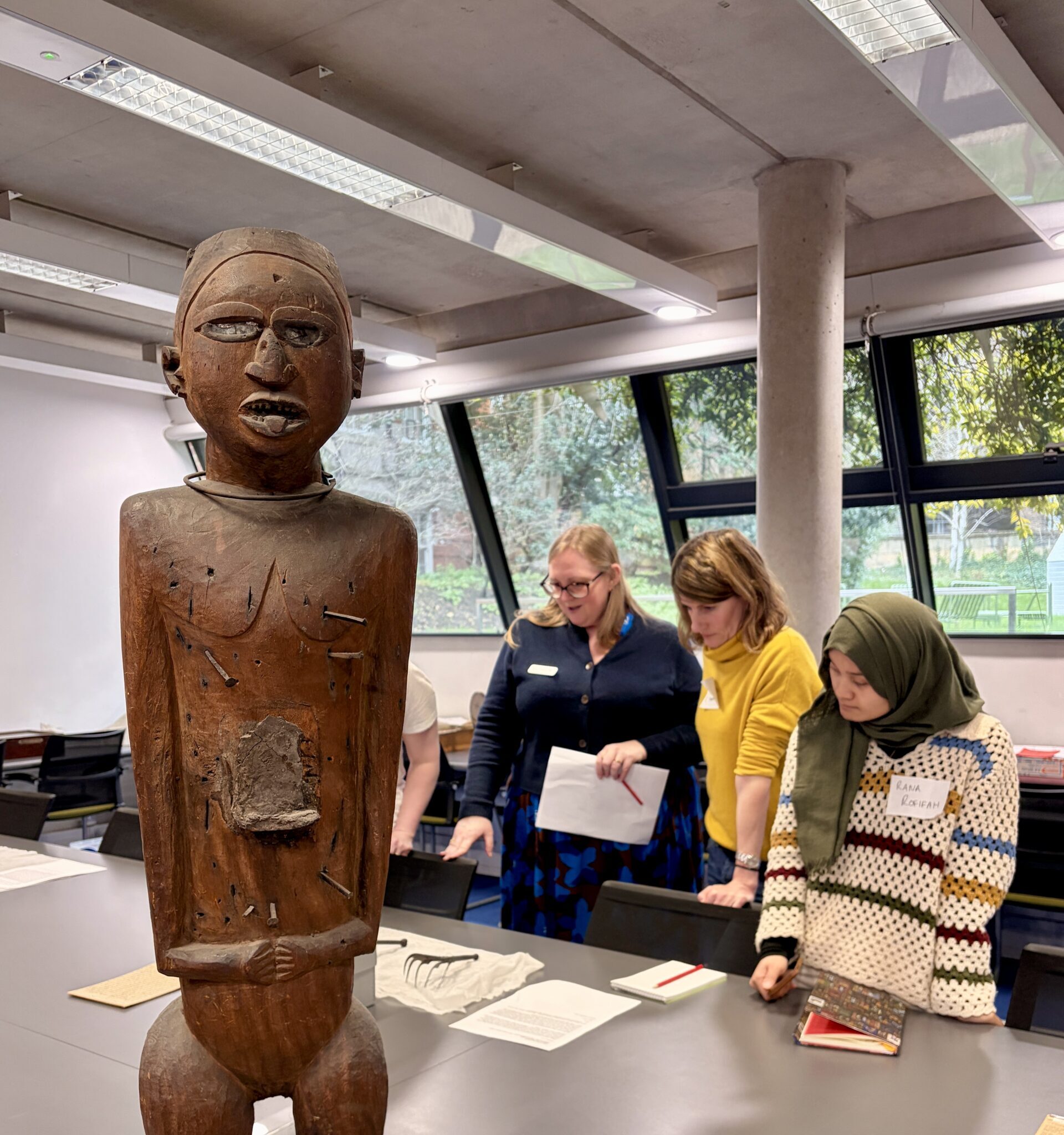
Image source: participants engaging with objects at the RGS, February 2026, Photo by Chloe Asker.
On Friday 27th February, Culture& Research Fellow Dr Chloe Asker hosted an event in collaboration with Dr Sarah Evans, the Head of Collections at the Royal Geographical Society (RGS) with the Institute of British Geographers (IBG). The workshop marked the start of a partnership between the two organisations as part of Culture&’s Reimagining Museums research programme, with the intention to develop future collaboration and creative work based on the Society’s collections.

Image source: Workshop in the Reading Room at the Royal Geographical Society, February 2026, Photo by Chloe Asker.
The morning session took place in the Society’s historic building in South Kensington (which opened in 1913, although the Society has existed since 1830), nestled next to Imperial College London. This area of London is nicknamed ‘Albertopolis’ because it is near the site of the 1851 Great Exhibition of the Works of Industry of All Nations and is the location of a series of cultural institutions, all founded by the consort of Queen Victoria and ‘Empress of India’, Prince Albert, whose gilded statue stands in Kensington Gardens, opposite the RGS building. As such, the area is “a central location in the symbolic geographies of the British capital, the nation and the empire”, and the strategic place of the “imperial archive”:
“The acquisition of objects from areas of the world in which Britain had colonial or proto-colonial political and military interests, and the ordering and displaying of them by a museum which was a department of the British state, formed, I suggest, a three-dimensional imperial archive. The procession of objects from peripheries to centre symbolically enacted the idea of London as the heart of empire.” (Barringer 2012, 20).
Geographers have critically interrogated the RGS’s embodiment of colonial history, as a specific institutional locus for geography that invites “the world to be explored and exploited by heroic geographers”, and its entanglement within violent histories of imperial rule and colonial expansionism (Griffiths and Baker 2020, 456). The RGS represents the institutional importance of geography as a system of knowledge that allowed imperial powers to dominate and control territories under colonial regimes. The geographical societies established in Europe played a leading role in racialising geospatial theories through travel, written accounts, cartography and expeditions which promoted the benefits of empire with an intense focus on colonial expansion in Africa, Asia and Australia (Godlewska and Smith 1994, 265).
The workshop offered an opportunity to engage with five objects from the Society’s vast collections, comprising of over 2 million items that relate to “geographical discovery and research”. The objects are all (un)tethered – specificities and details regarding their histories, provenance, and materialities are partially known or completely unknown, and even sometimes incorrect. Yet, they remain enduringly tethered to the imperial archive, with the language used to describe the objects in the catalogue recognised by participants as colonial and othering. Attendees at the workshop were offered the opportunity to engage directly with the objects in the Society’s Reading Room for around an hour. They were invited to take photos and make sketches using pencil and paper. After this period, participants reconvened upstairs to discuss and reflect on the objects in the collection using creative materials (collage and modelling clay) and the catalogue information (erasure poetry).


Image source: Attendee responses to the workshop at the Royal Geographical Society, February 2026, photo and scans by Chloe Asker.
Creative responses were varied and ranged from reflections regarding the colonial violence and whiteness that the archive espouses, to reimagining the function and form of the objects. Creative and multi-sensory activities allowed people to process challenging concepts and emotions relating to the objects. Whilst engaging with the objects was thought provoking and challenging, the process of reflecting on their experience through collage, modelling clay, and erasure poetry, allowed participants to process and engage proactively – rather than just sitting in discomfort and (white) shame, it encouraged embodied and multi-sensorial engagement with the nature of the objects, and the knowledges implicated.
Professor Victoria Tischler, who attended the event, commented that: ‘The object handling session was a particular highlight. The objects presented were diverse in form, material and provenance. They included a West African ‘fetish’ figure, a collar, attributed to Major Cecil Murphy’s dog who accompanied him in East Africa, Fijian batik cloth, and Congolese ‘tiger claws’. A hush descended as we gazed at, handled and sketched the items. Attendees were engaged in this activity for an extended period, with high levels of attention and absorption witnessed. It demonstrated the power of relics to act not simply as educational items but as conduits for modern, worshipful or restitutional events. The objects evoked a mix of emotional states from reverie and devotion to horror and revulsion.
Notes
Read more about the event on the RGS website.
Barringer, Tim. 2012. ‘The South Kensington Museum and the Colonial Project’. In Colonialism and the Object: Empire, Material Culture and the Museum, edited by Tom Flynn. London: Routledge. doi:10.4324/9780203350683.
Godlewska, Anne, and Neil Smith. 1994. Geography and Empire. Blackwell.
Griffiths, Mark, and Kate Baker. 2020. ‘Decolonising the Spaces of Geographical Knowledge Production: The RGS-IBG at Kensington Gore’. Area 52 (2): 455–58. doi:10.1111/area.12586.